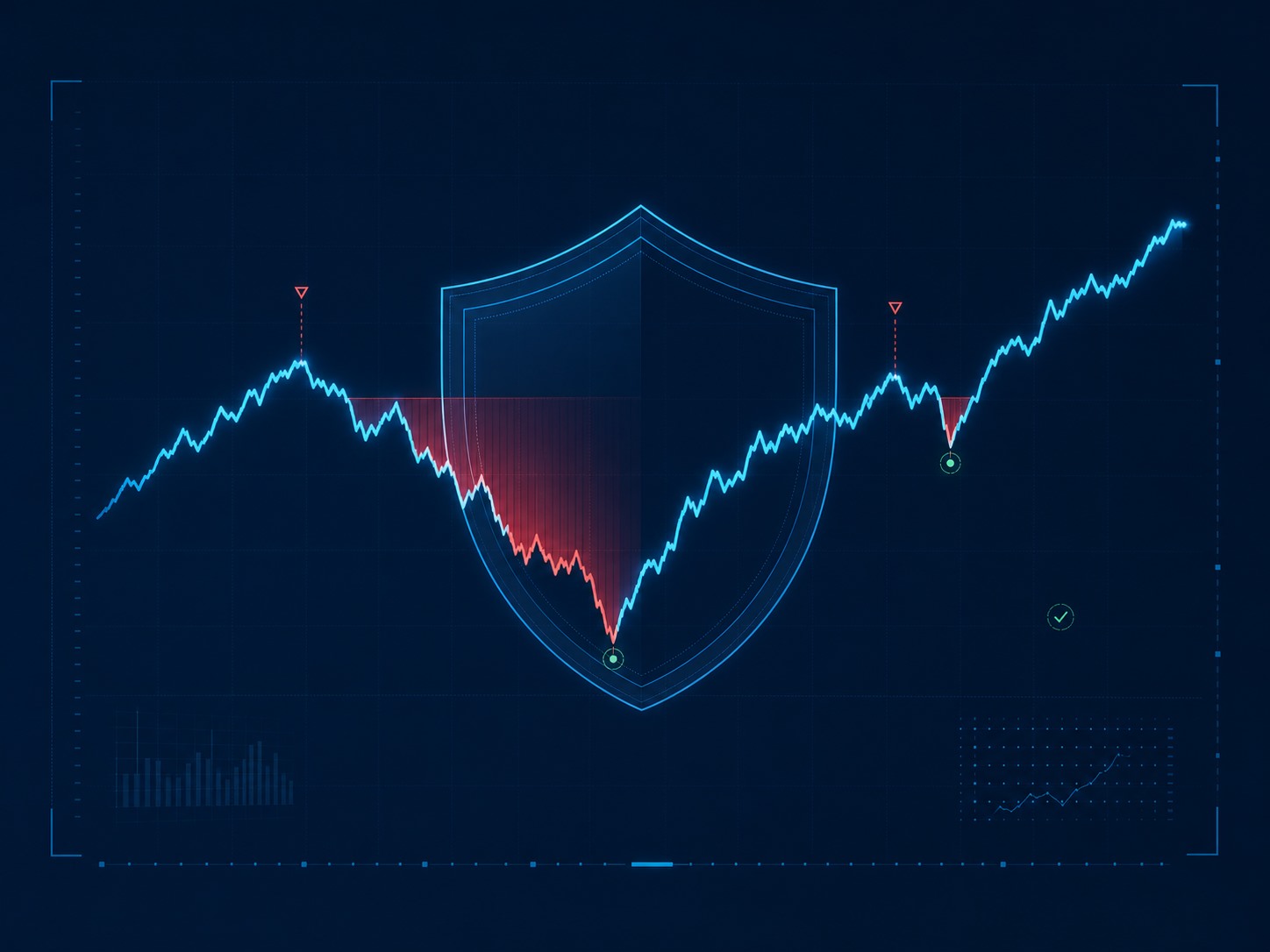
In professional capital management, return is not considered separately from risk. A strategy that can make a sharp profit in favorable market conditions, but loses control in times of stress, is not a sustainable investment system. Therefore risk management In quantitative terms, it starts not with the promise of profit, but with the question of how much loss is acceptable and how the system will behave in an unfavorable environment.
Algorithmic trading This allows you to turn these restrictions into enforceable rules. Trading algorithms do not eliminate market risk, but they can consistently measure it, limit exposure, and discipline when human decisions are most often emotional.
What is Risk Management of a Trading Algorithm
Risk management of trading algorithm It is a set of predefined rules that determine the size of the position, the maximum loss on the transaction, the allowable drawdown of the strategy and the total risk of the entire portfolio. These rules should be described before the system is launched, not selected at a time of market stress.
The main task of risk management in algorithmic trading is to protect the trading account from scenarios in which one trade, series of losses or concentration of positions can destroy the statistical advantage of the strategy.
Why risk is more important than maximum return
The investor is not interested in the best month of the strategy, but in the quality of the path to the result: the depth of drawdown, the speed of recovery, the stability of behavior in different liquidity and volatility regimes. A strong drawdown requires a disproportionately larger subsequent gain, so controlling losses is often more important than trying to maximize returns at all costs.
5.3%
11.1%
25%
42.9%
66.7%
100%
The drawdown and required returns for recovery are nonlinearly related. Therefore, limiting deep losses is more important than chasing maximum returns without predetermined limits.
Why Most Traders Lose Money
In practice, losses are often caused not by the lack of a trading idea, but by the lack of a process: a position increases after a loss, a stop is carried over under the influence of hope, and a strategy changes when the market has already caused damage. In manual trading, the pressure of volatility causes decisions to be inconsistent.
Systemic strategy The parameters are set before the risk arises: when a position is opened, when it closes, what loss is acceptable and at what level of instability the trade is reduced or suspended. This approach does not guarantee a positive deal, but protects the methodology from impulsive decisions.
How Trading Algorithms Control Risk
Capital controls are not limited to a single protective order. In an institutional architecture, it is a set of interrelated constraints that work at the transaction, strategy, and portfolio level. This approach helps to link capital management, position size, drawdown control and portfolio risk into a single system.
Protective stop orders.
A predetermined exit point limits the damage to an individual position and excludes uncontrolled retention of a loss.
Calculation of position size
The size of the transaction is calculated relative to the capital, the acceptable risk on the transaction and the current volatility of the instrument.
Volatility filters
With a sharp increase in market noise, the algorithm can reduce the volume of positions or miss the entry.
Balancing the portfolio
Limits are distributed across systems so that one idea does not dominate the overall risk profile.
Three levels of risk management
Risk management in algorithmic trading is more convenient to consider as a system of three levels. If one level is missing, the trading algorithm may look stable in the test, but lose control when the market regime changes.
Deal level
- position size;
- Protective stop order;
- the acceptable risk of the transaction;
- The ratio of potential profit to loss.
Strategy level
- maximum daily loss;
- maximum drawdown;
- Reduced volume after a series of losses;
- disabling the strategy when parameters are violated.
Portfolio level
- Total portfolio risk;
- correlation of systems;
- distribution of capital;
- Limit the risk of one market and simultaneous positions.
Formula for calculation of position size
The calculation of the size of the position relates the risk on the transaction with the distance to the stop order and the cost of the point. This allows you to use fixed monetary risk even when volatility and stops change from trade to trade.
Position size = allowable loss ÷ distance to stop order ÷ value of point
- Deposit: $10,000
- Deal risk: 1%
- Permissible loss: $100
- Distance to stop order: 50 points
- Cost of item: $2
100 ÷ 50 ÷ 2 = 1 contract
This approach helps to calculate the trading lot not by eye, but through a fixed risk. If the distance to the stop order increases, the position size should decrease; if the stop is closer, the position may be larger at the same monetary risk.
Why a fixed lot is not equal to a fixed risk
The same lot can create completely different monetary risk. If in one transaction the stop order is at 30 points, and in another - at 120 points, the same volume of the position leads to different load on the trading account.
The same goes for different tools. Volatility of NASDAQ, gold, currency pairs and CFDs varies, and the point value and average daily range can vary greatly. Therefore, a portfolio cannot be balanced only by the number of contracts: it is more important to take into account monetary risk, volatility and correlation of strategies.
Diversification as Capital Protection
One strategy is usually sensitive to a particular market regime: a trend, range, rise or fall in volatility. Portfolio diversification It combines systems with different logics and different sources of results. The goal is not for each strategy to earn at the same time, but for the overall portfolio to be less dependent on one type of market behavior.
Drawdown versus yield
High returns look convincing in the presentation, but for the allocation of capital more critical manageable drawdown. The investor must understand what risk was taken to produce the result and how repetitive the process was. The evaluation of a trading algorithm includes maximum drawdown, return-to-risk ratio, correlation with related systems, and behavior in market shocks.
Limitation of aggregate position
Capital stability is more important than a single peak of returnPosition limits and volatility filters smooth out the impact of extreme market movements.
Risk of trading system ruin
Risk of ruin It shows the probability that a series of losses will lead capital to a level beyond which it will be impossible to recover or continue trading. It’s not just a matter of one bad deal: the risk of ruin depends on how a strategy survives a long series of bad outcomes.
- risk per transaction;
- percentage of profitable transactions;
- the average ratio of profit to loss;
- length of series of losses;
- The number of simultaneously working strategies.
Why Martingale is Not Risk Management
Martingale is based on an increase in position after a loss. On the capital chart, this approach may look attractive for a long time, but the risk grows nonlinearly: each new attempt requires more volume, and one long series of losses can lead to a deep drawdown or loss of account.
Therefore, martingale does not replace the risk management of a trading algorithm. It can hide the tail danger and create the illusion of stability until the accident. A detailed analysis of this topic is better to make in a separate article about martingale and the risk of ruin.
How Algo Trade Systems Uses Risk Management
We consider trading algorithms as elements of a single portfolio infrastructure. At the research stage, the stability of logic on historical data and in various market regimes is checked. The strategy is then evaluated not in isolation, but in terms of its contribution to aggregate exposure and correlation with other algorithms.
A portfolio approach means that risk limits, rebalancing rules, and drawdown control are set before the system is launched. Priority is a transparent and measurable process in which potential returns are aligned with the acceptable volatility of the client’s capital.
Checklist of the Algorithm Risk Management Assessment
Before using a trading algorithm, it is important to evaluate not only the return of the test, but also how the system protects the trading account.
- Is there a protective stop order?
- how the volume of the position is calculated;
- what risk of the transaction is used;
- Is there a daily loss limit?
- is there a general drawdown limitation;
- whether correlation of strategies is taken into account;
- Can risk be changed without changing the trading logic?
- Whether commission and slippage are taken into account;
- What happens after a series of losses
- Is there a mechanism to stop the strategy?
Related material
To assess the risk of a trading algorithm in the context of testing and portfolio, it is useful to continue with these materials:
Algorithm doesn’t eliminate risk; it makes it manageable.
The market is always uncertain. The advantage of the algorithmic approach lies in the ability to execute rules without emotional deviation: limit losses, adjust position size, distribute risk between strategies and maintain discipline in difficult market conditions.
For the investor, this means a more mature basis for decision-making: not an expectation of unmistakable forecasts, but a controlled process of money management.