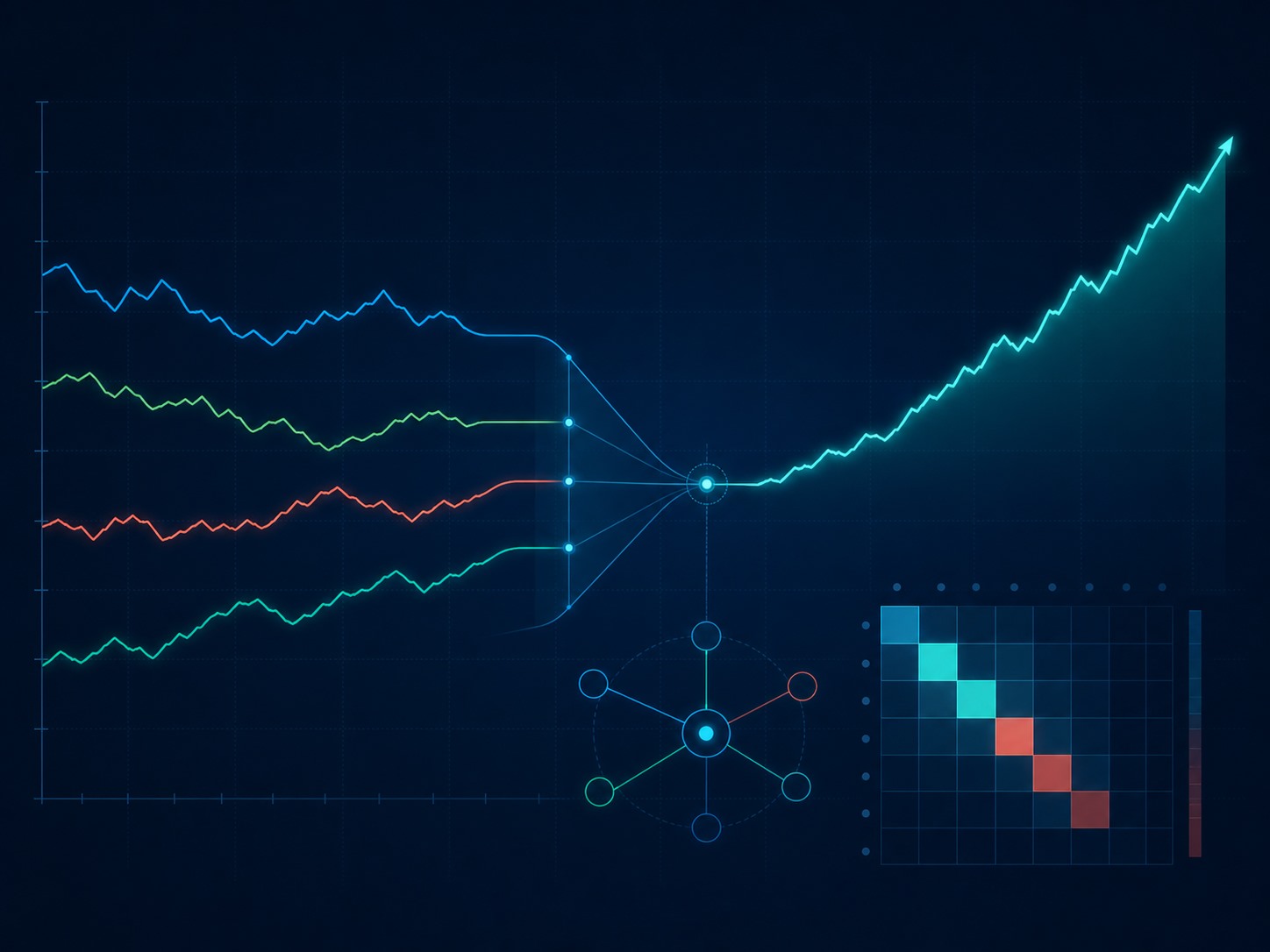
Even a persuasive strategy remains dependent on the conditions in which its logic works best. A trend model can show strong returns in a directional market and at the same time lose efficiency in a protracted range. For professional capital, a bet on a single source of output means concentration of risk.
Diversification of strategies This problem is solved systemically: several algorithms are combined into portfolioThe result is determined not by one idea, but by a set of independent sources of return. This is the foundation of an institutional approach to stability and risk-management.
What is Diversification of Strategies
In algorithmic trading, diversification is not just about increasing the number of algorithms. If several models open the same position in the same market, the portfolio actually keeps the same rate. Value arises when systems differ in terms of instruments, transaction horizons, signal sources, or responses to market conditions.
Portfolio of trading algorithms It is a set of algorithmic strategies that work together but use different markets, trading ideas, periods and sources of results. Large numbers of algorithms don’t mean diversification; it’s important that they don’t repeat the same economic exposure.
Why Five Similar Algorithms Are Actually One Strategy
Formally, there may be five trading algorithms in a portfolio, but economically they can place the same bet. For example, all five systems are breakout, trade stock indices, enter mainly in purchases, work over an hourly period and increase positions when volatility increases.
In a quiet period, this set can look diversified, because each algorithm has its own name and parameters. But in a stressful market, drawdowns will occur simultaneously. Therefore, a portfolio of non-correlating strategies is built not by the number of algorithms, but by the differences in markets, logic, directions, horizons and signal sources.
Why Different Strategies Strengthen Each Other
Portfolio effect occurs not because each system is profitable in each period, but because their weak phases do not have to coincide. Where one logic suffers a drawdown, another can stabilize the overall capital curve.
Different market phases
Trend strategies use directional movement, and return-to-average models can work more effectively in consolidation.
Different tools
Futures for indices, metals or currencies do not always go through stressful periods in sync.
Different logic
The momentum, return to average and volatility-based models create different profiles of inputs and outputs.
Correlation filter
High similarity of returns is revealed before the strategy is included in the overall portfolio.
Types of diversification of trading algorithms
For a portfolio of algorithmic strategies to be more sustainable than a single system, diversification must be multilayered. One market, one logic, and one direction rarely reduces the drawdown.
By market. m
- indexes;
- metals;
- currency;
- Energy, bonds and agricultural commodities.
Logically.
- Follow the trend;
- breakdown;
- return to the average;
- momentum, volatility and seasonal patterns.
In the direction
- only purchases;
- only sales;
- bilateral strategies;
- Limitation of general directional exposure.
Retention period
- intraday transactions;
- medium-term positions;
- long-term models;
- Different reactions to market speed.
From the source of the signal
- price;
- volatility;
- volume;
- Market profile and intermarket dependencies.
On platforms.
- TradeStation;
- MetaTrader;
- different brokers;
- Futures and CFDs.
Correlation: The Hidden Parameter of Stability
The two strategies may look different in name but lose capital on the same days. Therefore, professional analysis evaluates the correlation of results and joint behavior in stressful scenarios. Low to moderate correlation does not eliminate the risk, but reduces the likelihood of simultaneous deep drawdown of all components.
A +1 correlation means that the strategies move almost the same way. A value of about 0 indicates that there is little apparent linear connection. Correlation -1 means the opposite movement. But the correlation of profits is not constant: in a crisis it can increase sharply, so it is important to check not only the daily results, but also the coincidence of drawdown periods.
Example of a portfolio of trading algorithms
A practical portfolio can bring together algorithms that differ not only in the market, but also in the logic of entry, direction and behavior in the drawdown.
NASDAQ
Breakdown, shopping
Gold.
Follow the trend, buying and selling
DAX
Return to the average, buying and selling
Bonds
Impulse, shopping.
Such a set can be more stable than four similar algorithms on indexes, because the sources of the result are distributed among different markets, logics and directions. It still requires testing, but initially has a better chance of reducing the coincidence of drawdowns.
How Diversification Reduces Drawdowns
In a particular strategy, the capital curve can be sharp: a strong period of profit is replaced by a recovery phase. When systems are combined with correlations and limits, the overall result usually becomes evener. For an investor, this means less exposure to entry and a more predictable risk profile.
Reduced drawdown
Combined capital curve smooths individual loss cyclesRebalancing limits the impact of a strategy whose current phase has become unfavourable.
How to allocate capital between algorithms
An equal amount of money does not mean equal risk. Two strategies with the same capital can have different volatility, different drawdown, and different position size. Therefore, the allocation of capital between algorithms must take into account not only the amount, but also the risk of each component.
- Equal capital between strategies;
- equal risk to the strategy;
- distribution by volatility;
- distribution by maximum drawdown;
- the risk limit on the strategy;
- Risk limit per asset class.
Rebalancing the portfolio of trading systems
Once launched, the trading algorithm portfolio should not remain static. Market regimes change, individual strategies may temporarily deteriorate, and the contribution of one system may become too large relative to others.
Rebalancing can be calendar, for example once a month or quarter, or risk-based: reducing the weight of an unstable strategy, limiting the risk of one market, or eliminating the system if you violate predefined criteria. It is dangerous to redistribute capital only on recent returns: a better last month does not always mean better future resilience.
Why a portfolio of systems is better than a perfect strategy
The historically beautiful result of one model may be the result of over-optimization: the parameters are too precisely adjusted to the past piece of data. In addition, the structure of the market is changing: liquidity decreases, volatility and the nature of trends change. A system that dominates one mode does not have to maintain an advantage in the next.
The portfolio reduces the significance of this error. It doesn’t require finding a single ideal algorithm; instead, it combines several proven approaches with a limited input from each component. That's why. trading-algorithm The most convincing is not as isolated products, but as manageable elements of the general architecture of capital.
How to build a portfolio of trading algorithms
Building a multi-strategy trading portfolio does not begin with adding the maximum number of systems, but with checking the quality of each strategy and its role in the overall architecture.
- Check each strategy separately.
- Remove over-optimized systems;
- Compare markets and trading logic;
- Calculate the correlation of results;
- compare periods of subsidence;
- set risk limits;
- Collect a total backtest of the portfolio;
- to conduct Monte Carlo;
- Check the portfolio on data without optimization;
- launch with reduced risk.
Mistakes of diversification
Diversification of trading algorithms only works when the portfolio does spread risk. The most common errors are associated with the formal addition of systems without analyzing their economic similarity.
- Too many identical algorithms.
- Diversification by instrument names only;
- the same direction of all strategies;
- use of the general logic of entry;
- Estimate only the average correlation;
- Ignoring crisis periods;
- The same amount of money instead of the same risk.
- Adding a weak strategy just to reduce correlation.
How Algo Trade Systems uses a portfolio approach
When designing portfolios, we analyze not only the metrics of each strategy, but also its interaction with the rest: signal sources, markets, time horizons, loss distribution, and correlation of results. A strategy is included in a portfolio only when it reinforces the overall structure rather than repeating an existing exposure.
The professional diversification model applies risk limits, rebalancing rules, and monitoring the actual behavior of systems. The goal of this approach is not to maximize the short-term peak of returns, but to form a sustainable portfolio suitable for consistent evaluation by the investor.
Related material
To further assess portfolio resilience, it is useful to compare diversification with testing and risk management.
Stability is the result of architecture, not chance
A diversified portfolio does not exclude losses, but makes risk more distributed and observable. In algorithmic trading, this is especially important: the discipline of execution is complemented by the discipline of portfolio design.
For the investor, this approach means moving from a single hypothesis bet to a controlled decision system, where the sustainability of results is more important than short-term super-yields.